
What Is Portfolio Rebalancing — And Why Does It Matter?
Your Portfolio Doesn't Stay Still — And That's the Problem
You built your investment portfolio with a specific mix in mind — perhaps 70% in stocks and 30% in bonds, or some other combination that matched your goals and your comfort with risk. But markets don't stand still. Over months and years, some investments grow faster than others, and that original mix gradually shifts.
This shift is called portfolio drift, and left unaddressed, it can quietly change the risk level of your portfolio in ways you never intended. Portfolio rebalancing is the process of bringing your investments back in line with your original targets — and it's one of the most practical, often overlooked elements of long-term investment management.
What Is Portfolio Rebalancing?
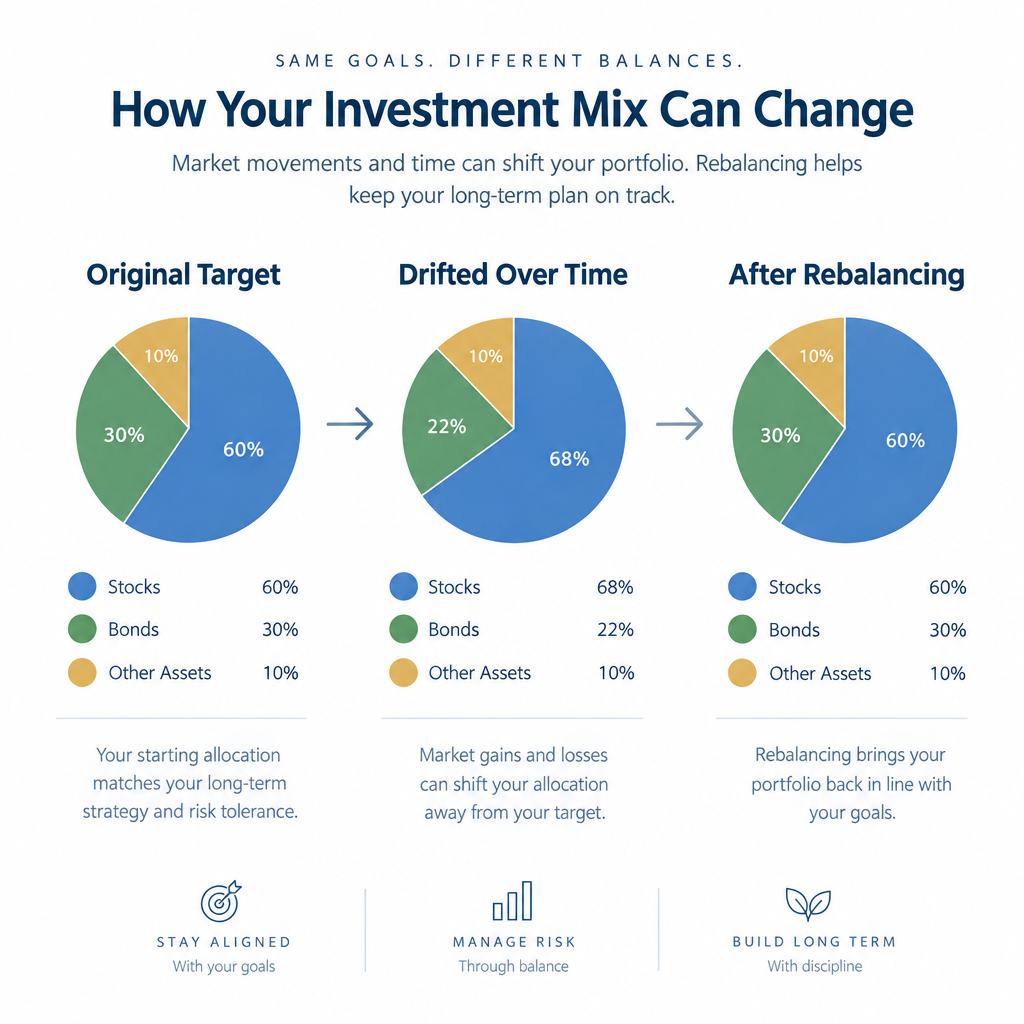
Portfolio rebalancing is the process of realigning the weightings of the assets in your portfolio to match your intended target allocation. In simple terms: when one part of your portfolio grows faster than another, rebalancing brings everything back into balance.
For example, imagine you started with a portfolio that was 60% stocks and 40% bonds. After a strong year for equities, stocks may now represent 72% of your portfolio and bonds just 28%. Your portfolio has drifted — and with it, your exposure to risk has changed, even though your actual goals and risk tolerance have not.
Rebalancing corrects that drift by trimming the positions that have grown beyond their target weight and adding to those that have fallen below it — returning the portfolio to its intended balance.
Why Does Portfolio Drift Happen?
Portfolio drift is a natural consequence of investing. Different asset classes — stocks, bonds, real estate investment trusts, international holdings, and others — perform differently at different times. When one category outperforms over a period of time, it represents a larger share of your total portfolio. When one category lags, it shrinks relative to the rest.
This is not a flaw in your investment strategy. It is simply how markets work. But it does mean that a portfolio you designed carefully at one point in time may look very different a year or two later — even if you haven't made a single intentional change.
A Practical Example
Suppose you invested $100,000 with a 60/40 stock-bond target — $60,000 in stocks and $40,000 in bonds. Over the following year, your stock holdings grow to $78,000 while your bonds grow modestly to $43,000. Your portfolio is now worth $121,000, but your stock allocation has risen to approximately 64% — and your bond allocation has fallen to about 36%.
If stocks experience a sharp downturn the following year, that unintentional overweight in equities could translate into larger losses than your original strategy was designed to absorb.
Why Rebalancing Matters for Long-Term Investors
1. It Helps Keep Your Risk Level Consistent
Your target allocation reflects your risk tolerance — how much short-term volatility you are willing to accept in pursuit of long-term growth. When your portfolio drifts, your actual risk level changes. Rebalancing helps ensure that your portfolio stays aligned with the risk level you originally determined was appropriate for your situation.
2. It Reinforces Investment Discipline
Rebalancing requires selling assets that have performed well and adding to those that have underperformed. That can feel counterintuitive. But this discipline — often described as a systematic way of buying lower and trimming higher — can help investors avoid the emotional tendency to chase recent performance and concentrate too heavily in what has been working.
3. It Helps Maintain Diversification
Diversification — the practice of spreading investments across different asset classes, sectors, and geographies — is one of the foundational principles of investment management. It is designed to reduce the impact of any single investment's poor performance on your overall portfolio. When a portfolio drifts significantly, it may become less diversified than intended, concentrating more exposure in whatever has recently performed best.
Rebalancing restores the diversification you originally planned for.
4. It Keeps Your Plan Connected to Your Goals
Your investment strategy is not just about performance — it is about your specific financial goals, your timeline, and your life circumstances. As you get closer to retirement, for example, many investors choose to gradually reduce equity exposure and shift toward more stable assets. Rebalancing is part of how that transition happens in a thoughtful, planned way.
How Often Should You Consider Rebalancing?
There is no single universally correct answer, but there are two common approaches investors and their advisors use:
Calendar-Based Rebalancing
This approach involves reviewing and rebalancing at set intervals — quarterly, semi-annually, or annually — regardless of how much your portfolio has drifted. It is straightforward and consistent, making it easier to establish as a habit. Many investors conduct an annual review as part of their broader year-end financial planning process.
Threshold-Based Rebalancing
This approach involves rebalancing when a specific asset class drifts beyond a defined range from its target — for example, when any allocation moves more than 5 percentage points away from its target weight. This method responds to actual market movements rather than fixed dates, which may make it more responsive to significant market swings.
Some investors and advisors combine both approaches, reviewing on a calendar schedule but only rebalancing when drift has exceeded a meaningful threshold.
Considerations to Keep in Mind
Rebalancing is generally a sound investment discipline, but there are practical considerations that may affect how it's approached in any specific situation:
- Tax implications in taxable accounts: Selling investments that have appreciated in value may trigger capital gains taxes. In taxable accounts, investors may want to consider the tax efficiency of how they rebalance — for example, by directing new contributions toward underweighted positions rather than selling appreciated assets. A tax professional can help evaluate the specific implications for your situation.
- Account type matters: In tax-advantaged accounts like IRAs or 401(k)s, rebalancing generally does not create an immediate tax event, which can make it more straightforward to manage.
- Transaction costs: Some investment accounts may involve transaction fees when buying or selling positions. Understanding your account's cost structure is worth considering.
- Frequency vs. cost and complexity: Rebalancing too frequently may generate unnecessary costs without meaningfully improving outcomes. Finding a reasonable balance is part of a thoughtful approach.

Rebalancing Is a Process, Not a One-Time Event
One of the most important things to understand about rebalancing is that it is not something you do once and forget. Markets change. Life circumstances change. Your goals may evolve as you move through different stages — starting a family, approaching retirement, or shifting your financial priorities.
A well-managed investment approach builds rebalancing into the ongoing rhythm of financial planning rather than treating it as a reaction to a market event. Regular portfolio reviews help ensure that your investments continue to reflect where you are today and where you are headed — not just where you were when you first invested.
Rebalancing is one of the ways that disciplined, long-term investors help keep their portfolios working toward their actual goals, rather than simply following wherever recent market performance has led.
Questions Worth Discussing with a Financial Professional
- Does my current portfolio allocation still reflect my risk tolerance and timeline?
- How much has my portfolio drifted from its original target?
- What rebalancing approach — calendar-based, threshold-based, or a combination — makes sense for my situation?
- How should I think about tax efficiency when rebalancing in taxable accounts?
- How should my target allocation shift as I get closer to my financial goals?
Your Portfolio Should Work for Your Life — Not Drift Away From It
Portfolio rebalancing is not about reacting to market noise or trying to time the market. It is about maintaining the investment strategy you deliberately chose — one that reflects your goals, your timeline, and your tolerance for risk.
Over years and decades, that consistency of approach can matter as much as any individual investment decision.
If you are unsure whether your current portfolio reflects your original intentions — or if you have never reviewed it since you first invested — it may be worth taking a closer look.
Financial decisions are rarely one-size-fits-all. If you'd like to talk through how portfolio rebalancing fits into your broader investment strategy and financial goals, schedule a consultation with Eden Advisory Services.
This article is for general educational purposes and should not be considered individualized investment, tax, or legal advice. Financial decisions should be evaluated based on your individual circumstances and, when appropriate, with qualified financial, tax, or legal professionals. Past investment performance does not guarantee future results.