
2026 Retirement Contribution Checklist: What to Maximize Before December 31 and What is Coming in 2027
November is here, which means the window to maximize your 2026 retirement contributions is closing. For most workplace retirement accounts — including 401(k), 403(b), and 457 plans — December 31 is the hard deadline. Miss it, and that contribution room is gone for good.
This is also the time of year when the IRS typically announces the following year's contribution limits. For 2027, actuarial forecasters have published projections based on September 2026 Consumer Price Index data — and another meaningful increase appears likely across several account types.
Whether you are trying to squeeze the most out of 2026 or start planning ahead for 2027, this checklist covers what you need to know.

The 2026 Retirement Contribution Limits at a Glance
The IRS sets annual limits on how much you can contribute to tax-advantaged retirement accounts. Here are the confirmed 2026 figures:
401(k), 403(b), and Most 457(b) Plans
- Employee contribution limit: $24,500
- Catch-up contribution (age 50 and older): $8,000 — bringing the total to $32,500
- Super catch-up (ages 60 to 63, per SECURE 2.0): $11,250 — bringing the total to $35,750
- Combined employee and employer limit: $72,000
- Contribution deadline: December 31, 2026
Traditional and Roth IRAs
- Contribution limit: $7,500 (combined across Traditional and Roth IRAs)
- Catch-up contribution (age 50 and older): $1,100 additional — total of $8,600
- Contribution deadline: Tax filing deadline in April 2027, giving you extra time after year-end
Health Savings Accounts (HSAs)
- Self-only coverage: $4,400
- Family coverage: $8,750
- Catch-up (age 55 and older): $1,000 additional
HSAs are worth noting in a retirement context because unused funds carry over indefinitely and can be invested, making them a meaningful long-term savings vehicle for healthcare costs in retirement.
Five Things to Review Before December 31

1. Check How Much You Have Actually Contributed This Year
Many people assume they are on track without confirming it. Log in to your 401(k) account, check your year-to-date contributions, and compare them to the 2026 limit. If there is room left, you may be able to increase your contribution rate for your remaining paychecks before December 31.
Keep in mind that payroll systems often have a processing cutoff before the calendar year ends. Check with your HR or benefits department about the last pay date that will count toward 2026.
2. Confirm Your Employer Match Is Not Being Left on the Table
If your employer offers a matching contribution, make sure your contribution rate is structured to capture the full match. Front-loading contributions early in the year can sometimes cause you to hit the employee limit before year-end — and if your plan does not offer a year-end true-up feature, you could miss employer match dollars for the remaining pay periods. This is worth a quick review, especially if you increased your contribution rate earlier in 2026.
3. Take Advantage of Catch-Up Contributions If You Are 50 or Older
Workers age 50 and older can contribute an additional $8,000 to a 401(k) or 403(b) on top of the standard $24,500 limit. If you turned 50 this year, this catch-up eligibility may be available to you for the first time. Confirm that your plan has catch-up contributions enabled and that your current deferral election reflects the higher limit.
4. Understand the SECURE 2.0 Super Catch-Up Rule If You Are Ages 60 to 63
If you will be age 60, 61, 62, or 63 at any point during 2026, you may be eligible for an enhanced catch-up contribution limit of $11,250 — in addition to the standard $24,500 — for a combined employee limit of $35,750. This provision was introduced by the SECURE 2.0 Act and creates a narrow four-year window for additional contributions during the years just before many people retire. If you fall in this age range and have not confirmed whether your plan offers this option, now is the time to check with your plan administrator.
5. Know About the Roth Catch-Up Requirement for Higher Earners
Starting in 2026, a new rule under SECURE 2.0 applies to workers who earned more than $150,000 in wages subject to Social Security tax (FICA wages) from their employer in 2025. If you fall into this category and are age 50 or older, catch-up contributions in 2026 must be made as Roth contributions — meaning they are made with after-tax dollars rather than pre-tax dollars. This change does not prevent catch-up contributions; it only changes how they are taxed. However, it does require that your plan supports Roth contributions. If yours does not, speak with your HR or benefits team about how this may affect your planning.
Roth vs. Traditional: A Consideration Worth Revisiting at Year-End
If your employer plan offers both traditional pre-tax contributions and Roth contributions, year-end is a reasonable time to consider whether your current mix still makes sense for your situation.
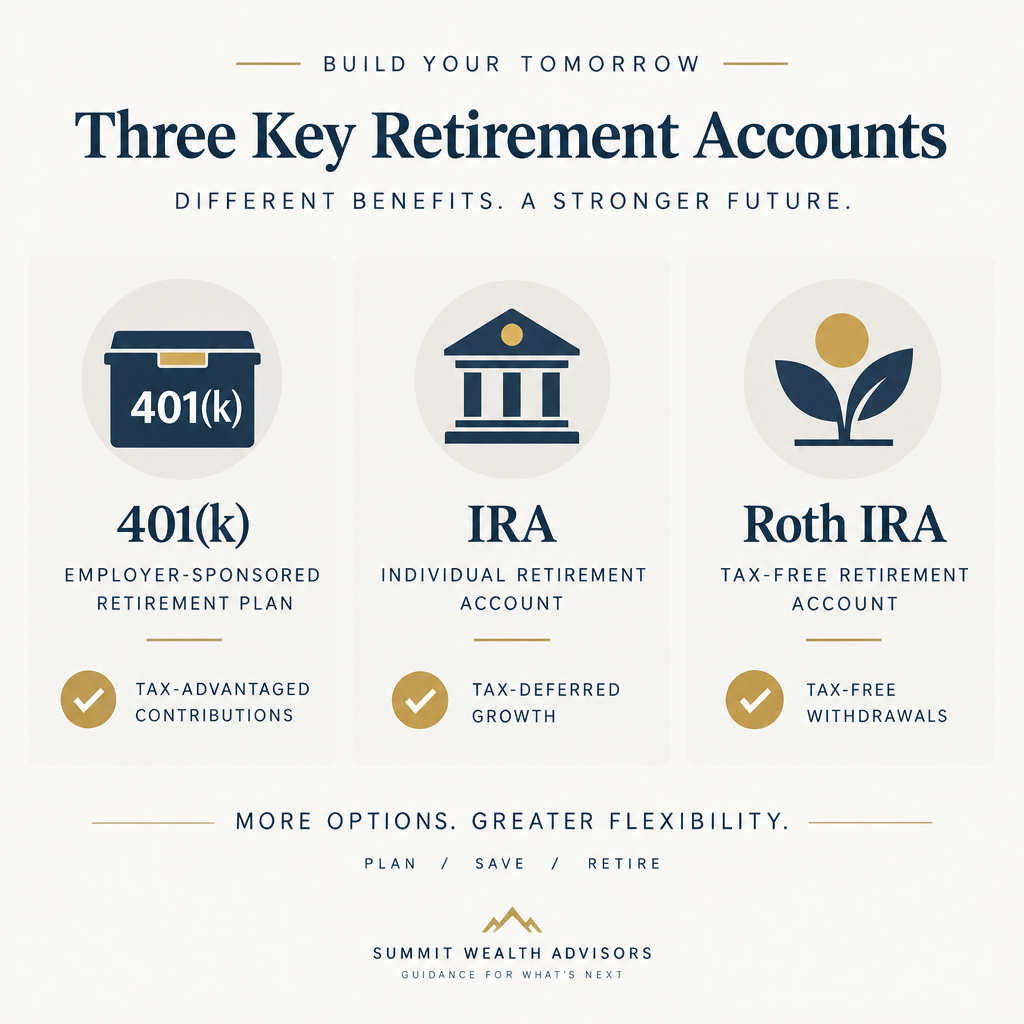
Traditional contributions reduce your taxable income now and are taxed when withdrawn in retirement. Roth contributions are made after tax, but qualified withdrawals in retirement are generally tax-free — and Roth accounts are not subject to required minimum distributions during your lifetime under current rules.
Whether one approach is more appropriate than the other depends on factors including your current tax bracket, your expected income in retirement, and your broader financial picture. Some people find value in contributing to both types — a practice sometimes called tax diversification — to build a balance of pre-tax and after-tax retirement assets that may provide flexibility in managing taxable income in retirement. This is a meaningful planning question that a financial professional can help evaluate based on your specific circumstances.
Do Not Overlook Your IRA — You Have Until April
Unlike 401(k) plans, Traditional and Roth IRAs have a contribution deadline that extends to the tax filing deadline — generally April 15, 2027 for the 2026 tax year. This gives you additional time to fund an IRA even after December 31.
However, Roth IRA eligibility phases out at higher income levels. If your modified adjusted gross income is near the Roth IRA phase-out thresholds for 2026, it may be worth confirming your eligibility before contributing — or discussing alternatives such as a backdoor Roth IRA strategy with a qualified financial and tax professional.
A Look Ahead: What Is Projected for 2027
The IRS typically announces the following year's retirement contribution limits in late October or November. As of early November 2026, the official 2027 limits have not yet been released. However, independent actuarial firms have published final projections based on September 2026 Consumer Price Index data.
Important: The following are projections based on independent actuarial analysis, not official IRS figures. Treat them as preliminary planning guidance only until the IRS publishes its official notice.
- 401(k)/403(b)/457 employee limit (projected): $25,500 — an increase of $1,000
- Standard catch-up at age 50 and older (projected): $8,500
- Super catch-up for ages 60 to 63 (projected): $11,750
- IRA limit (projected): Most projections expect the limit to remain at $7,500, as IRA limits adjust only in $500 increments and forecasters are divided on whether the inflation threshold has been met
- HSA self-only (official, already confirmed by IRS): $4,500
- HSA family (official, already confirmed by IRS): $9,000
If the projected 401(k) limit is confirmed at $25,500, savers who have been contributing at the 2026 maximum may want to update their contribution elections in January. A practical planning step: once the IRS makes the official announcement, divide the new limit by your number of pay periods to confirm the right deferral amount going into 2027.
Practical Questions to Ask Before Year-End
- Have I confirmed my 2026 year-to-date contributions against the applicable limit?
- Am I on track to receive my full employer match?
- If I am age 50 or older, have I activated catch-up contributions with my plan?
- If I am ages 60 to 63, have I confirmed whether my plan offers the enhanced catch-up limit?
- If I earned more than $150,000 in FICA wages in 2025 and I am 50 or older, does my plan support Roth contributions for the required catch-up treatment?
- Is my IRA contribution for 2026 funded or planned before the April 2027 deadline?
- Have I reviewed whether my traditional vs. Roth contribution mix still aligns with my planning goals?
Why These Decisions Are Worth a Closer Look
Retirement contribution decisions may feel routine, but they have meaningful long-term consequences. Whether you are deciding how much to contribute, which account type to prioritize, or how to position yourself as new limits take effect, these choices interact with your broader financial picture — including your income, tax situation, retirement timeline, and other savings goals.
Maximizing contributions consistently over time is one of the more reliable long-term savings habits available to working adults. Even modest increases in annual contributions, maintained over years, can have a meaningful compounding effect by the time retirement arrives.
Financial decisions are rarely one-size-fits-all. If you would like to talk through how these contribution considerations fit into your broader retirement and financial goals, schedule a consultation with Eden Advisory Services. Our team works with individuals, families, and business owners to help bring clarity to retirement planning at every stage.
This article is for general educational purposes and should not be considered individualized investment, tax, or legal advice. Contribution limits described as projected or estimated for 2027 reflect independent actuarial forecasts and have not been officially confirmed by the IRS as of the publication date of this article. Financial decisions should be evaluated based on your individual circumstances and, when appropriate, with qualified financial, tax, or legal professionals. Always verify current IRS limits at IRS.gov before making contribution decisions.